 |
||||||||||||||||||
|
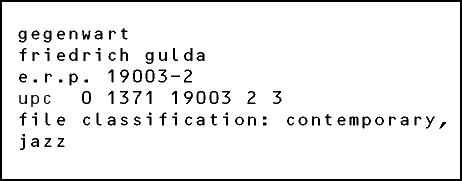 
the projectOne often hears that a piece of music is "ahead of its time"; however, the claim is difficult to prove until a certain amount of time has passed. In January of 1976, the great Austrian pianist Friedrich Gulda recorded the album Gegenwart (meaning presence or present time), which can now truly claim, with its 1993 reissue, to have been ahead of its time. The album was a collaboration with percussionist Ursula Anders and producer Eckart Rahn; it was and still is a challenging, dramatic collection of improvisations.Actually, past, present, and future, all come together in Gegenwart. Gulda's worldwide reputation as an interpreter of classic Mozart and Beethoven pieces certainly did nothing to prepare listeners for the music on this recording. From its recognizably pianistic sounds to the guitar like strumming produced on (or more accurately, in) the electric clavichord, Gegenwart is a musical snapshot of a musician looking toward the future. It contains no solo piano works and the conventional sounds of the piano are simply one of a number of textures that Gulda uses. At times, dramatic and abstract, sometimes spare and lyrical, Gegenwart is full of surprises. For instance, the strings inside the piano imitate an electric-bass and the high swoop of a synthesizer at the end of Duo 1 and Duos 2 and 3 include an assortment of percussion instruments, recorders, and even some whistling. Although all of the pieces are completely improvised, this is not an album of conventional jazz. Gegenwart is about sound, not form; as its German title indicates, it's about playing in the moment—about the act of making music. Even now, the album contains some of the most unusual sounds ever coaxed out of a piano or clavichord. More important, the pieces sound like they could have been recorded last month; the music is as daring and imaginative now as it was in 1976. the artistFriedrich Gulda was one of the most original and iconoclastic musicians of the 20th century. His career as a famed classical pianist reached its pinnacle in 1970 when he was awarded the Beethoven Bicentennial Ring by the Vienna Academy of Music. He then returned the award as a protest against a musical education system in Europe that he considered too conservative. Gulda had a continuing interest in contemporary and improvised music. As far back as the 1960s, he began composing, improvising, and collaborating with like-minded musicians. Perhaps his most notable collaborative albums were those with American pianist Chick Corea, another artist for whom composed and freely improvised music are two sides of the same coin. Gulda played and recorded the classical repertoire, especially Beethoven, and played jazz as well as less categorized forms of improvisation. He also occasionally played recorders and electric keyboards. Gulda passed away in 2000 at his home in Austria. He was 69. tracklist
|
||||||||||||||||||



|
||||||||||||||||||
 |